Food manufacturing has become a data-driven industry. Producing high-quality food products today requires more than reliable recipes and skilled labour. Manufacturers must manage raw materials, production schedules, quality controls, packaging, inventory, compliance, and distribution in a tightly coordinated environment.
Food ERP systems provide the digital backbone that connects these moving parts. By unifying production, inventory, quality, and compliance data into a single system, ERP platforms help food manufacturers operate with greater accuracy, speed, and resilience.
Key Takeaways
- Food ERP systems unify production, inventory, quality, and compliance into one operational platform
- Real-time visibility improves decision-making, reduces waste, and protects product integrity
- Integrated ERP workflows support sustainability, traceability, and ethical supply chain management
ERP Systems for Efficient Food Manufacturing
Food manufacturing is a continuous chain of interconnected activities. Ingredients are sourced, received, stored, processed, packaged, and distributed, often under strict regulatory and timing constraints. Any breakdown across this chain can affect product quality, safety, or profitability.
Food ERP systems bring structure to this complexity by centralizing operational data and automating coordination across departments. Production planning aligns with inventory availability. Quality checks are embedded directly into workflows. Compliance documentation is generated automatically as work is performed.
This system-wide coordination allows manufacturers to respond faster to demand changes, reduce operational friction, and maintain consistent output across product lines.
The Four Operational Pillars of Food ERP Systems
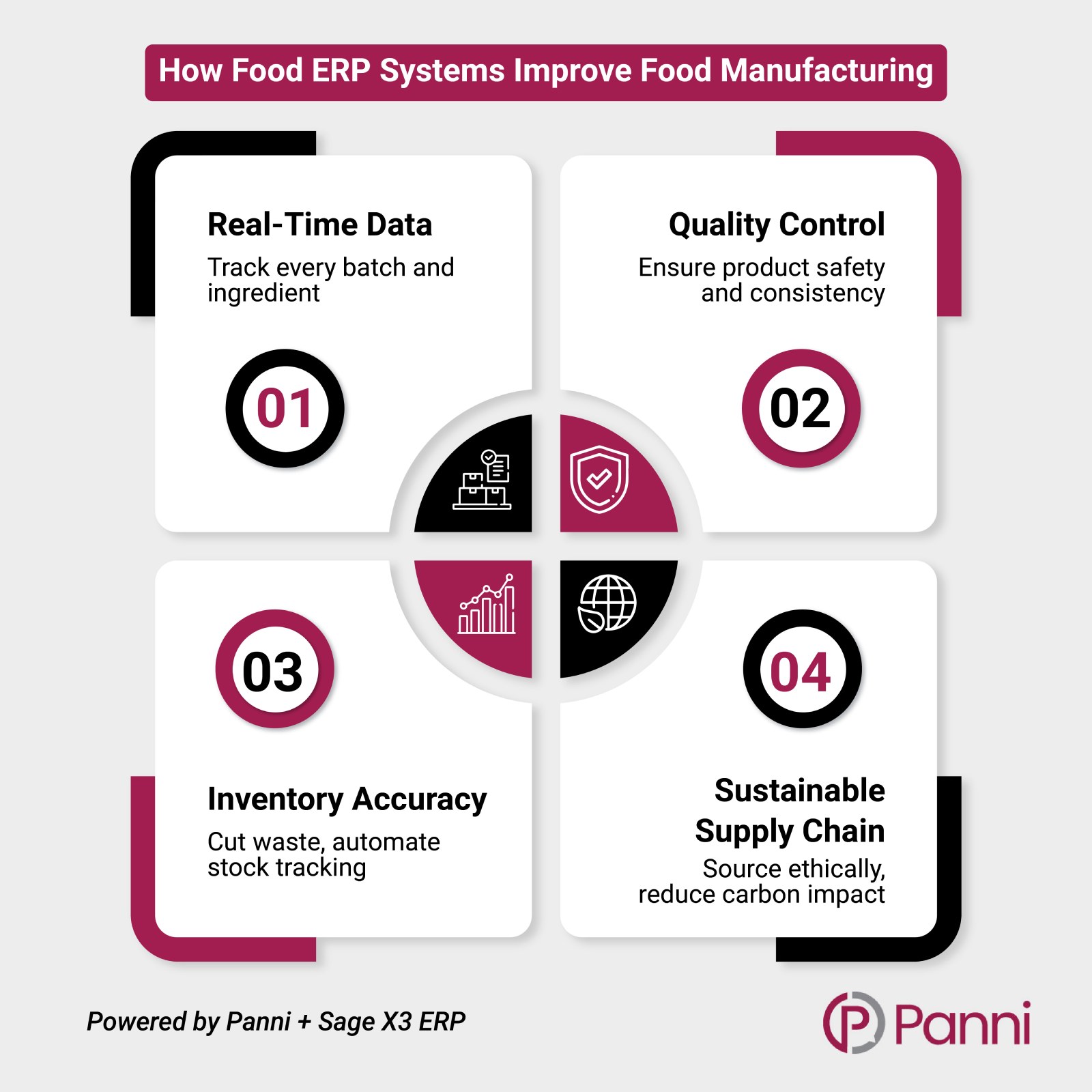
Modern food ERP platforms are built around four core capabilities that directly impact manufacturing performance.
1. Real-Time Data Across Production and Inventory
Food ERP systems capture live data from procurement, production, quality checks, and inventory movements. Every batch, ingredient, and process step is recorded as it happens.
This real-time visibility allows teams to:
- Monitor batch status and ingredient usage instantly
- Identify bottlenecks or deviations before they escalate
- Make faster, data-backed production decisions
Instead of reacting to reports after the fact, manufacturers operate with up-to-the-minute insight across the plant floor.
2. Built-In Quality Control and Food Safety Oversight
Quality control is not a separate function in a food ERP system. It is embedded directly into daily operations.
ERP-driven quality management supports:
- Ingredient inspections and acceptance testing
- In-process quality checks and deviations
- Packaging integrity and labelling verification
- Automated non-conformance tracking and corrective actions
By integrating quality into production workflows, manufacturers protect product safety while maintaining consistency at scale.
3. Inventory Accuracy and Waste Reduction
Inventory inaccuracies drive waste, production delays, and lost revenue. Food ERP systems maintain precise inventory visibility across raw materials, work-in-progress, and finished goods.
With automated inventory tracking, manufacturers can:
- Prevent overproduction and stock expiry
- Optimize reorder points and safety stock
- Reduce manual counting and reconciliation errors
Accurate inventory data supports uninterrupted production while lowering carrying costs and waste levels.
4. Sustainable and Transparent Supply Chains
Sustainability and ethical sourcing are now operational requirements, not marketing claims. Food ERP systems support responsible manufacturing by tracking supplier performance, sourcing practices, and environmental metrics.
Manufacturers can use ERP data to:
- Verify supplier compliance and certifications
- Track ingredient origins and ethical sourcing
- Measure waste, energy use, and emissions
This transparency strengthens compliance, improves reporting, and supports long-term sustainability goals.
Raw Material Tracking and End-to-End Traceability
Raw material control is the foundation of food safety and consistency. Food ERP systems track every ingredient from supplier receipt through production and final shipment.
When materials enter the facility, the ERP records:
- Supplier details and certifications
- Lot and batch numbers
- Expiry dates and storage requirements
As ingredients move through production, each transaction is logged automatically. This creates complete traceability across procurement, processing, packaging, and distribution.
In the event of a recall or audit, manufacturers can identify affected products in seconds, reducing risk and response time.
Compliance with Food Manufacturing Regulations
Regulatory compliance is embedded into food ERP systems by design. Platforms like Sage X3 support compliance with frameworks such as:
- HACCP
- FSMA
- CFIA Safe Food for Canadians Regulations
- GFSI-aligned standards
ERP systems automate audit trails, inspection records, and corrective action logs. This eliminates manual paperwork while keeping manufacturers in a constant state of audit readiness.
Quality Assurance and Product Consistency
Consistency is essential in food manufacturing. ERP systems help enforce standardized processes while allowing flexibility across product lines.
Quality teams can:
- Define acceptance criteria for ingredients and packaging
- Monitor deviations in real time
- Identify recurring quality risks through historical data
This proactive quality management approach improves customer satisfaction while reducing rework and product loss.
Inventory Optimization and Production Continuity
Food ERP systems link inventory data directly with production planning. Manufacturers gain clear visibility into what materials are available, what is reserved, and what needs replenishment.
This alignment enables:
- Better production scheduling
- Reduced downtime from material shortages
- Improved supplier coordination
Inventory accuracy becomes a strategic advantage rather than an operational burden.
Recipe and Formula Management
Recipe management within food ERP systems ensures consistency while supporting innovation. Centralized recipe controls allow manufacturers to manage formulations, portioning, and substitutions without introducing risk.
ERP-based recipe management:
- Standardizes production across batches and facilities
- Reduces formulation errors
- Simplifies scaling and product development
All recipe changes are version-controlled and traceable for compliance and quality assurance.
Food Packaging Quality Control Through ERP
Packaging is a critical control point for food safety, shelf life, and brand integrity. Food ERP systems manage packaging quality alongside production and inventory data.
ERP-based packaging control includes:
- Approved material specifications and supplier tracking
- Seal integrity and packaging inspections
- Labelling accuracy and regulatory compliance
By linking packaging performance to production batches, manufacturers strengthen traceability and recall readiness.
Advanced Analytics and Decision Support
Food ERP systems transform operational data into actionable insight. Real-time dashboards provide visibility into production efficiency, costs, and quality performance.
Advanced analytics enable:
- Demand forecasting and capacity planning
- Early identification of inefficiencies
- Continuous improvement initiatives
AI-driven insights help manufacturers stay proactive in a highly competitive market.
Achieving Sustainable Growth with Food ERP Systems
Food ERP systems are no longer an optional infrastructure. They are the foundation for scalable, compliant, and sustainable food manufacturing.
By integrating production, quality, inventory, traceability, and analytics into one system, ERP platforms allow manufacturers to operate with confidence and agility.
FAQ
What makes Food ERP systems different from general ERP platforms?
Food ERP systems are designed specifically for the complexities of food manufacturing, including perishability, traceability, and regulatory oversight. They manage lot tracking, expiry dates, quality checks, and compliance documentation as part of daily operations. Unlike general ERP platforms, food ERP systems embed food safety and quality controls directly into production workflows. This specialization helps manufacturers maintain consistency, safety, and regulatory readiness at scale.
How do Food ERP systems improve traceability and recall management?
Food ERP systems track every raw material, batch, and finished product from supplier receipt to final distribution. Each transaction is recorded automatically, creating a complete digital trail across production and packaging. In the event of a recall, manufacturers can quickly identify affected lots, customers, and distribution channels. This speed reduces risk exposure, limits product loss, and supports regulatory compliance.
Can Food ERP systems help reduce waste and improve sustainability?
Yes, Food ERP systems provide real-time visibility into inventory levels, expiry dates, and production usage. This accuracy helps manufacturers prevent overproduction, reduce spoilage, and optimize purchasing decisions. ERP data also supports tracking of supplier practices, energy usage, and waste metrics. Together, these capabilities enable more responsible, efficient, and sustainable food manufacturing operations.
ERP as the Backbone of Modern Food Manufacturing
Food ERP systems give manufacturers the operational control required to manage complexity at scale. By connecting production, quality, inventory, traceability, and compliance into a single source of truth, ERP platforms reduce waste, protect product integrity, and support consistent execution across facilities. Panni helps food manufacturers achieve this level of control by implementing Sage X3 solutions designed specifically for food and beverage operations. With Panni as your ERP partner, manufacturers gain a scalable foundation that supports compliance, efficiency, and long-term growth in an increasingly data-driven industry.